





Enter your VAT number here and click Verify:
Your details have been verified. VAT number registered to:
,
.
Your order will now be zero rated for VAT purposes. We reserve the right to verify these details after your order request has been made and reinstate VAT if required.
Your VAT details were not recognised or were invalid. Your VAT number must be matched to your Billing Country as specified above. This is currently specified as . You do not need to enter the country code part of your VAT number as this has already been selected in your billing address details above.
The VAT number checking service is currently offline. Please supply your VAT details within the comments or special instructions field below and we will apply a VAT discount after placing your order request.
Performance Friction Brakes

This Product Fits:

Porsche 996 GT3 MKII 02-05 Front
Porsche 996 GT2 02-05 Front
Porsche 997 Turbo 06>> Front
Porsche 997 GT3 06>> Front
Porsche 997 GT3 RS 06>> Front
Porsche Carrera GT 03>> Front

Porsche Carrera GT 03>> Rear
The problem of brake fluid boiling is simply traced to heat transferring from the rotors and pads directly into the fluid through the caliper pistons. When brake fluid boils, it releases air that is normally part of the molecular structure of the fluid. This air is compressible of course, and the brake pedal goes to the floor instead of moving the caliper pistons. Production cars tend to suffer from this on track days more as they don't usually have the extensive cooling duct and exotic brake materials as true racing cars. True racing only brake calipers generally come with titanium caliper pistons for one reason. Titanium as a material has low thermal conductivity. This means that it is very bad at transferring heat, which is fantastic if you are trying to keep your fluid cool.
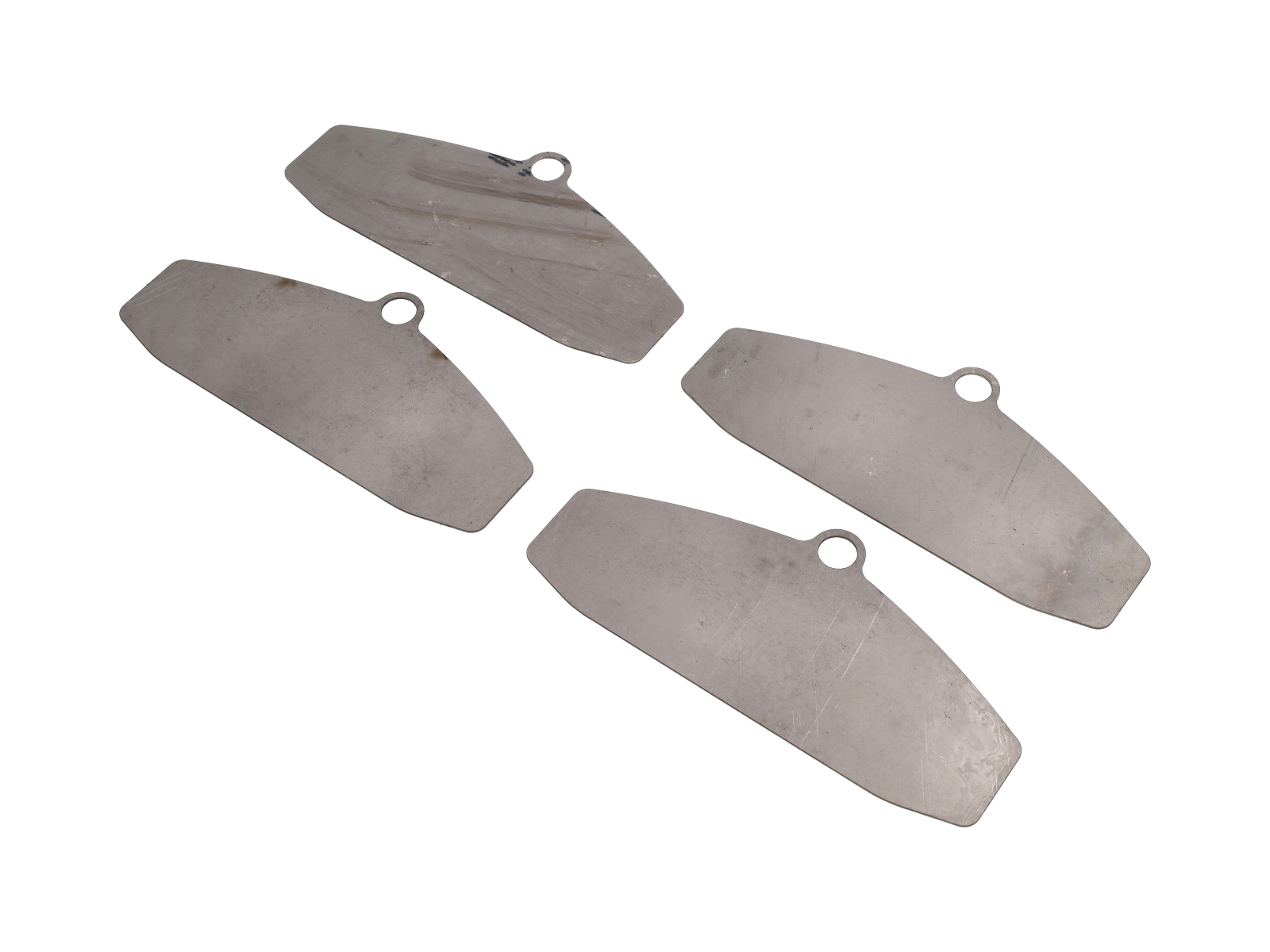
The Girodisc solution to help prevent fluid boiling is to use a thin titanium shim placed between the pad back and the pistons, to keep the braking heat from transferring into the pistons and fluid. Here is a comparison of materials and their relative thermal conductivity ratings:
Titanium 6AL-4V 6.7 W/mk
Steel 52 W/mk
Aluminum 130 W/mk
You can see that Titanium will transfer far less heat than steel and especially aluminum. For cars that are going to see hard or multiple track days, these shims are cheap protection from losing the pedal due to boiling at the wrong time and making the day very expensive.
Water jet cut to exact size, no cutting, grinding, or swearing involved.
Price is per axle (four pieces)
Related reference numbers
Related, superseded, cross reference or alternative numbers for comparison.
TS-991-4
The product you are viewing cross references to these numbers

- Porsche 996 GT2 2001-05
- Porsche 996 GT3 MKII 2003>>
- Porsche 996 GT3 RS 2003-04
- Porsche 997 MK1 TURBO 2007-09
- Porsche 997 MK1 GT3 2007-09
- Porsche 997 MKII GT3 2010-11
- Porsche 997 MKII Turbo 2010-13
- Porsche Carrera GT 2003-06
 Shop Securely
 12 Month Warranty
 Worldwide Delivery
Performance Friction Brakes (PFC) - Motorsport & High-Performance Braking Solutions
Performance Friction Brakes (PFC) are globally recognised for delivering exceptional braking performance, thermal stability, and consistency across motorsport, track-day, and high-performance road applications. Trusted by professional race teams and performance enthusiasts alike, PFC brake pads and discs are engineered to provide predictable friction behaviour, excellent pedal modulation, and outstanding fade resistance under extreme conditions.
At Design911, our range of PFC braking components includes race-proven brake pads and high-performance discs designed to perform reliably during aggressive driving, sustained track use, and competitive motorsport. Whether you’re upgrading for circuit work or demanding road performance, PFC brakes deliver confidence where braking precision matters most.
What Do Performance Friction Brakes Do?
PFC braking components convert kinetic energy into controlled stopping force with exceptional consistency and control.
Core Functions:
- Deliver stable, repeatable braking performance at high temperatures.
- Maintain consistent friction across a wide operating range.
- Provide precise pedal feel and modulation.
- Reduce brake fade during repeated heavy braking.
- Support high-performance and motorsport braking systems.
PFC brakes are designed to perform reliably from the first lap to the last, even under extreme load.
Why Do High-Performance Brakes Wear or Fail?
Performance driving and motorsport place significant stress on braking systems.
Common Causes of Wear or Failure Include:
- Extreme
heat generation leading to material breakdown.
- Aggressive
braking loads accelerating pad and disc wear.
- Thermal
cycling causing cracking, glazing, or distortion.
- Using
road-grade components in track environments.
- Extended service intervals beyond recommended limits.
As braking components degrade, performance consistency and safety are compromised—making replacement essential for high-demand applications.
Why Replace with Performance Friction Brakes (PFC)?
PFC components are engineered to long outlast and outperform standard braking solutions under demanding conditions.
Key Benefits:
- Motorsport-derived friction materials and disc technology.
- Exceptional fade resistance and thermal stability.
- Predictable, confidence-inspiring pedal feel.
- Proven reliability in sprint, endurance, and track-day use.
- Wide compound selection to suit different driving styles and disciplines.
Replacing worn components with PFC brakes ensures braking performance remains precise, consistent, and reliable when it matters most.
Highlights
- Motorsport-grade brake pads and discs.
- Designed for extreme heat and repeated high-load braking.
- Consistent friction and excellent pedal modulation.
- Trusted by professional racing teams worldwide.
- Suitable for track days, competition, and high-performance road use.
Porsche Brake Disc Upgrades: Venting, Drilling, and Grooving Explained
Today we’re talking brake discs: the unsung heroes of your Porsche’s stopping power. What do they do? How can you tell when they need replacing? And what are the upgrade options for enhanced performance? It’s all here. We’ll explore the evolution of brake disc designs, from solid to vented, drilled, and grooved, explaining how each type improves performance. Plus, we’ll break down the materials: durable cast iron, high-carbon steel, and Porsche’s high-performance options like carbon ceramic and surface-coated discs. Whether you’re looking for better braking on the track or a cost-effective daily driving solution, we’ve got you covered.-
 Brake Pads & Disc Package
-
Brake Disc Standard
-
Brake Pads Standard
-
SPORTS Brake Disc
-
Brembo Standard brakes
-
Brembo Racing brakes
-
TEXTAR Brakes
-
PAGID Racing Brakes
-
Giro Slotted Brake Disc
-
Replacement for Ceramic Disc
-
Brake Pad Wear Sensors
-
Brake Pad Anti-vibration shims
-
Caliper Bolts / Disc Screws
-
Pin Kit and Guide Plates
-
Performance Brake Hoses
-
Standard Brake Hoses
-
Caliper and Brake Lines
-
Brake Calipers
-
Brake Caliper Upgrades
-
Handbrake Shoes
-
Brake Disc Cover Plates
-
ABS | Speed Sensors
-
Caliper Seals |Pistons
-
Brake Servo | Booster
-
Brake Master Cylinder
-
Brake Fluid Reservoir
-
Brake Fluid
-
Titanium Brake Pad Shields
-
DesignTek Brake Kits



Monday-Friday: 8.30am - 5.30pm (GMT)
Saturday: Closed
Sunday: Closed